How to Dry Apple Rings at Home
Core, slice, dip and dry apples until they are leathery, then condition and jar them. A dehydrator at 60°C does the job a radiator will not.
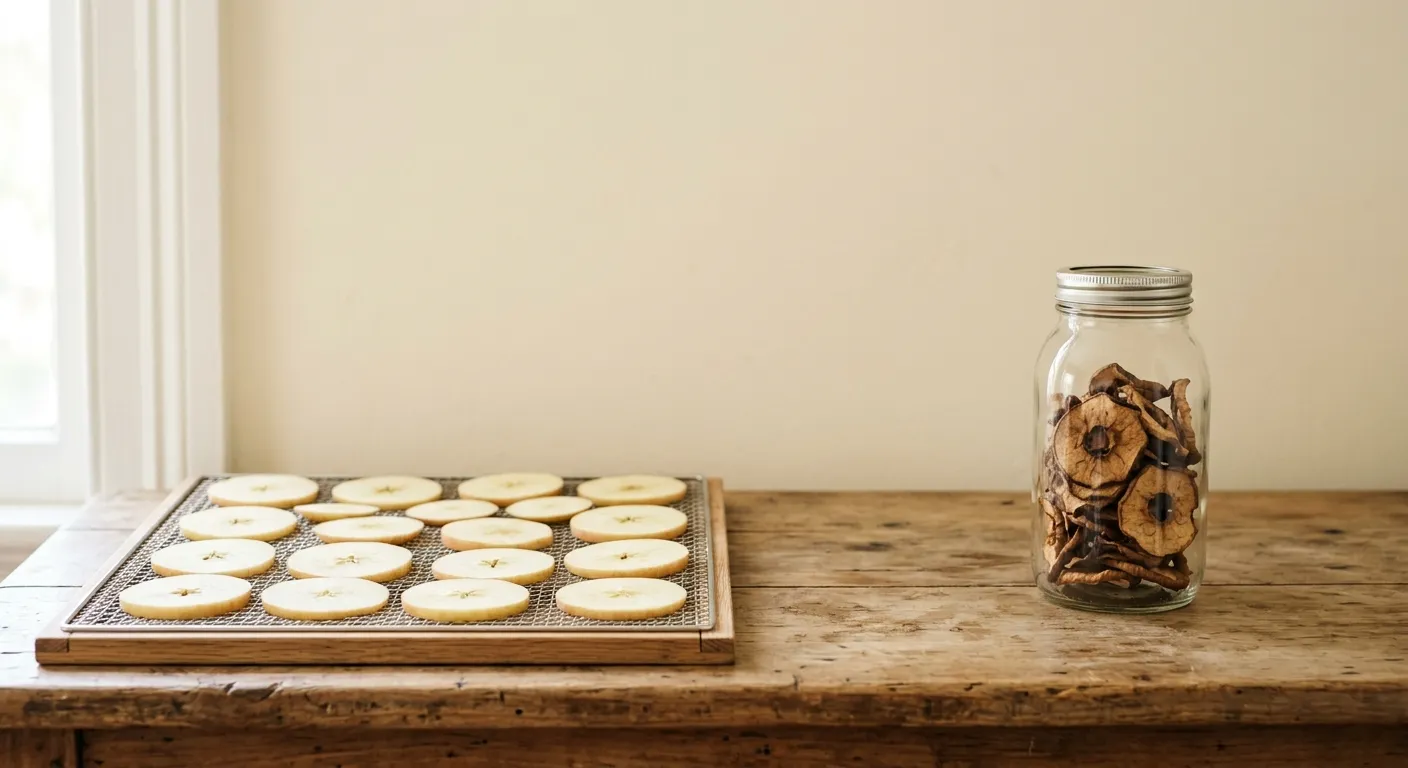
What you end up with
Dried apple rings are apples with most of the water gone. The sugars and the fibre stay, which is why a small handful tastes sweet and why the same weight of fresh apple would be a much larger snack.
USDA FoodData Central lists a cup of dried, sulfured, uncooked apples (about 86 grams) at about 209 kilocalories, with roughly 7 to 8 grams of fibre. Home-dried rings without sulfites will be darker. The calories land in the same range, because the change is water leaving the fruit. They are still a sugary food. A small bowl is a snack. A jar in an afternoon is a lot of sugar with a wholesome name.
People have dried apples for a very long time, and by the medieval period they were an ordinary winter fruit in northern Europe. The useful modern detail is the temperature. University extension services dry fruit at about 60°C (140°F) with air moving over it. A string of slices over a radiator, or near a hearth that is not actually hot and dry, often leaves the centre damp. Damp fruit moulds in the jar.
Apples, knife, and a dip
Choose firm, ripe apples. Soft fruit dries into a wet rag. Wash them. Cut out bruises.
Core them. Peel if you want a tender ring. Peel left on slows drying, because water has to leave through the skin, and the skin toughens. Either is edible.
Slice evenly, about 3 to 6 millimetres (1/8 to 1/4 inch). Thinner slices become chips. Thicker slices take longer and are the ones people under-dry. Uneven slices finish at different times, which is how a damp piece gets packed with dry ones.
Pretreating keeps the colour and adds a mild acid dip. Penn State Extension gives two household options, with a 10-minute soak:
- Equal parts bottled lemon juice and water.
- Or an ascorbic-acid dip: 3 3/4 teaspoons of powdered ascorbic acid, or twenty crushed 500 mg vitamin C tablets, or 1/2 teaspoon of citric acid, dissolved in 2 cups of water.
Drain well. Do not rinse the lemon dip off. South Dakota State University Extension uses the same lemon-juice soak.
Sulfite dips hold colour for longer storage. Skip them if anyone who will eat the apples has asthma. Lemon juice is the right default for a family kitchen.
Dry at 60°C until the centre is leathery
A dehydrator is the tool that matches the guidance. Heat it to 60°C (140°F). Lay slices in one layer, not touching. Colorado State University Extension and the University of Missouri both use that temperature, and both put apple drying in a band of roughly 6 to 12 hours, sometimes longer if the slices are thick or the air is humid. Check toward the end. Fruit scorches once the surface is dry.
Penn State suggests starting near 63°C (145°F) for the first hour if the slices are wet on the surface, then dropping to 57–60°C (135–140°F). Too hot, and the outside seals while the inside stays wet. That is called case hardening, and those slices spoil later.
Done: take a few slices out and let them cool for a few minutes. They should be pliable and leathery. Cut one open. The centre should show no moist patch, and pressing them should not leave beads of moisture. Sticky slices need more time.
Oven, if you have no dehydrator. It has to hold about 60–65°C (140–150°F). Many ovens cannot. Their lowest mark is closer to 90°C (200°F), which case-hardens fruit. If yours can go low enough, prop the door open a few centimetres so steam leaves, and use a fan to move air if you have one. It takes hours and a lot of electricity. Missouri's drying guide notes that apples are the fruit most worth doing this way; other fruits are a poor use of an oven.
A radiator or a sunny windowsill. Only consider it in genuinely hot, dry air, and only if you then test the centres the same way. Extension services prefer a dehydrator because slow drying is when yeasts and moulds keep growing. If you did hang slices and any of them feel cool and limp rather than leathery, they are not finished. Put them in the dehydrator or a low oven.
Condition, then jar
Cool the rings completely before they go into a container. Warm fruit sweats, and that moisture is enough for mould.
Conditioning evens out the water left in the pieces. The National Center for Home Food Preservation says to pack the cooled fruit loosely in a glass or plastic jar, seal it, and leave it for 7 to 10 days. Shake the jar daily. If you see condensation, or the rings start to stick, they go back on the dryer. After a clean conditioning period, pack them tightly in clean, dry jars. Smaller jars are better, because every time you open a large one you let moisture in.
If the fruit was dried where insects could reach it, Penn State recommends a pasteurising step before storage: 70°C (160°F) in the oven for 30 minutes, or 48 hours in a freezer at -18°C (0°F) or below.
Store the jars in a cool, dark, dry place. NCHFP's range for most dried fruit is about a year at 15°C (60°F) and about 6 months at 27°C (80°F). The freezer holds quality longer. Glass lets you see moisture on the inside. If the rings smell fermented, look fuzzy, or feel damp, throw them out. You cannot trim mould off dried fruit the way you can trim a hard cheese.
How to eat them
A small handful is the snack. They also go into porridge, a salad, or a pan with a splash of water if you want them soft again.
Write the date on the lid. Put the new jar behind the old one. Three apples become a jar you will actually finish, which is a better start than a bushel you are bored of by November.
Dried apple questions
How thick should apple rings be?
About 3 to 6 millimetres, or 1/8 to 1/4 inch, and all of them the same thickness so they finish together.
What temperature dries apples safely?
About 60°C (140°F) in a dehydrator, with air moving, until a cooled slice is leathery and shows no moisture in the centre. Plan on 6 to 12 hours and judge by the fruit, not the clock.
How long do home-dried apples keep?
The National Center for Home Food Preservation gives about a year at 15°C (60°F) and about 6 months at 27°C (80°F), after the rings have been conditioned and packed dry. Sooner if the jar lives in a warm kitchen.
Can I dry them on a string by the heater?
Only if the air is hot and dry enough that the centres actually finish, which you check by cutting a cooled slice. A dehydrator at 60°C is the method extension services describe, because slow drying leaves moisture for mould.
Where this comes from
Method and storage: NCHFP, packaging and storing dried foods, Penn State Extension, dried apples, South Dakota State University Extension, dehydrating apples, Colorado State University Extension, drying fruits, and University of Missouri Extension, how to dehydrate foods. The cup of dried apples at about 209 kilocalories is the USDA FoodData Central entry for apples, dried, sulfured, uncooked, household measure 1 cup (86 g). Your apples will differ with variety and how dry you took them.
Related guides
Be prepared!