Hazelnuts and Chestnuts for a Winter Snack Tin
Hazelnuts keep if you protect them from air and warmth. Fresh chestnuts do not. Here is how to store each one, and how to tell a sweet chestnut from a horse chestnut.
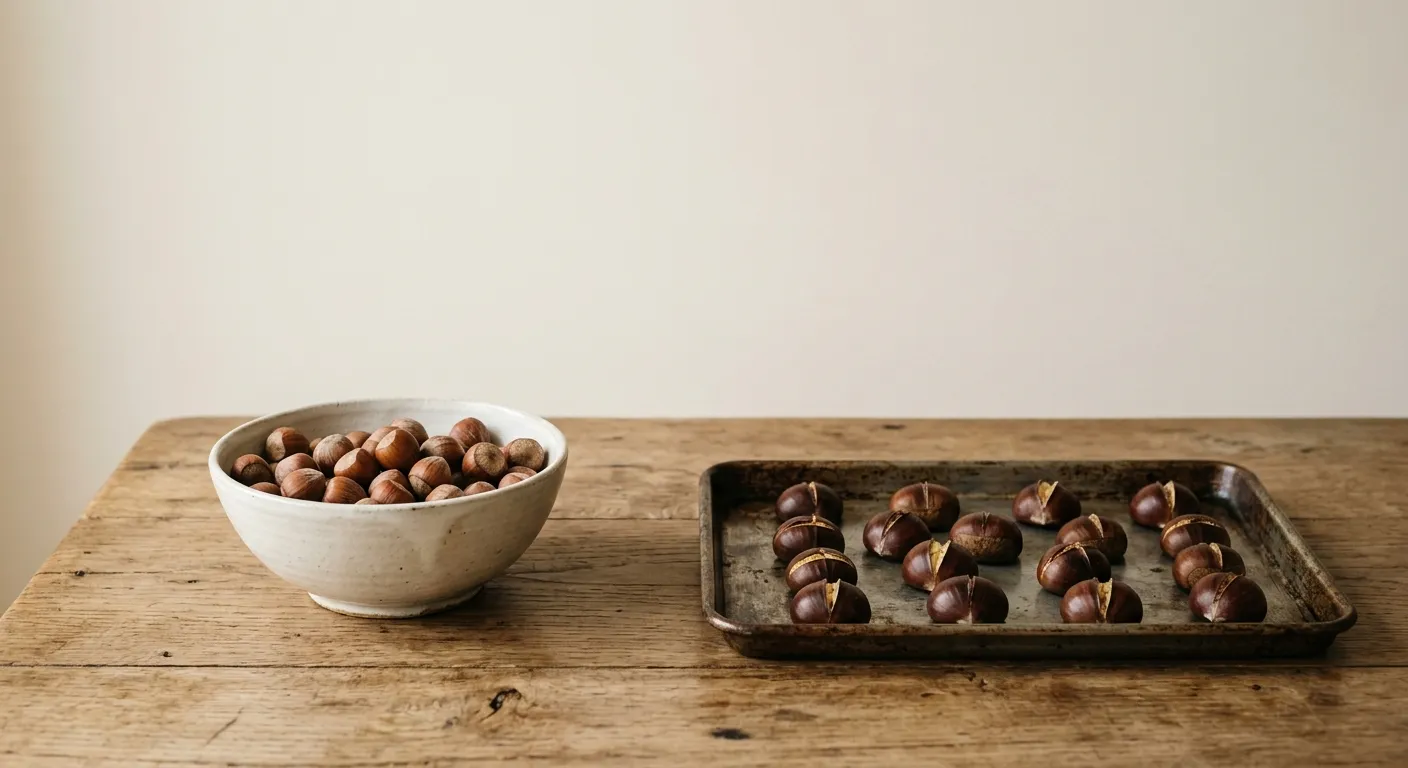
Two nuts, two different jobs
Hazelnuts are an oily, high-calorie snack you can carry in a pocket once they are out of the shell. Chestnuts are a starchy food, closer to a small roast potato than to a walnut, and the fresh ones go mouldy if you treat them like hazelnuts.
USDA FoodData Central puts raw hazelnuts at about 15 grams of protein and about 60 grams of fat per 100 grams. That is why a small handful is filling, and why the fat goes rancid if the nuts sit in the light and the warmth. Roasted European chestnuts are listed at about 245 kilocalories per 100 grams and about 350 kilocalories per cup (about 143 grams), with only a couple of grams of fat per 100 grams. They have some vitamin C when freshly cooked. It is not a reason to live on them. It is a reason they are a different snack from a bag of hazelnuts.
Hazelnuts grow wild across much of Europe and were gathered food as well as farmed food. In mountainous parts of southern Europe, chestnut flour stood in for wheat where grain crops failed, which is why old texts call the chestnut a bread tree. Buy this year's crop from a grocer unless you already know the tree. The safety section below is the reason.
Hazelnuts
In-shell nuts keep longer than shelled ones, because the shell slows air and light reaching the oil. Shelled nuts are what you will actually eat, so store those properly.
Put them in a clean, dry, airtight jar. A cupboard is fine for a few weeks if the room is cool. For longer than that, use the fridge or the freezer. Freezing does not ruin a hazelnut. Heat, air and light do. Rancid nuts smell like oil paint or putty. Spit them out and throw the jar away. Rancid fat is not a thrift project.
Eat them as they are, or toast them in a dry pan until they smell sweet. Salt is optional. A handful with an oatcake or a piece of cheese is the whole snack. You do not need a bar built around a nut paste, unless you like that bar. Read the label either way: the nut is the useful part, and the rest of the ingredients are there for texture and shelf life in a wrapper.
Fresh chestnuts, then the flour
Fresh sweet chestnuts are moist. In a bowl on the counter they mould, sometimes within a couple of weeks, sometimes faster in a warm kitchen. Buy them heavy and shiny. Skip any with holes, which can mean an insect got there first, and any that rattle, which have dried out inside.
Keep fresh chestnuts in the fridge, in a paper bag or a perforated bag so they are cold without sitting in a puddle. Use them within a few weeks, and look them over. White or green mould means that nut goes in the bin. One mouldy nut in a bag is a reason to check the rest, not a reason to wash and hope.
Roasting. Cut a slit through the skin of each nut, or they can burst. A cross works. Roast at 200°C (400°F) for about 20 to 30 minutes, until the shell splits back and the inside is tender. They are best hot. Cooled roast chestnuts keep a few days in the fridge, covered. They are a snack for this week, not a jar for March.
Freezing. Roast or boil, peel while warm (the skin comes off more easily), cool, and freeze in a bag. That is the household way to keep a glut.
Dried chestnuts and chestnut flour are the actual winter store. Dried nuts rehydrate in water and go into soups and stews. Flour belongs in an airtight tin in a cool cupboard, or in the freezer if you will be months using it. It is a gluten-free starch. It bakes differently from wheat: denser, sweeter, and it stales in a way wheat flour does not. Use it in a flat cake or a porridge-like bake, and expect a different crumb.
Sweet chestnut or horse chestnut
Horse chestnuts, the conkers, are not food. They are poisonous. Sweet chestnuts are the edible ones. If you are not already confident, buy them.
When you are looking at a tree you know well, the usual differences are:
- Sweet chestnut (Castanea sativa): two or three nuts in a case covered in a dense mass of fine spines. The nut comes to a point and often has a little tassel at the tip.
- Horse chestnut (Aesculus hippocastanum): usually one rounded, glossy nut. The case is leathery with short, widely spaced spikes, not a hedgehog of fine spines. There is no pointed tassel.
The Woodland Trust sweet chestnut and horse chestnut pages show both. A mixed hedge is a bad place to learn. Children collect conkers; those stay out of the kitchen.
Nut and chestnut questions
How should I store hazelnuts?
In an airtight jar. A cool cupboard is fine for a short while. The fridge or freezer is better if they will sit for months. Throw them out if they smell like paint or taste bitter and stale.
Why do fresh chestnuts go mouldy?
They are moist, unlike hazelnuts. Keep them cold, in the fridge, and use or freeze them within a few weeks. Dried chestnuts and chestnut flour are the forms that belong in a pantry.
How do I roast chestnuts without them exploding?
Cut a slit in the shell of every nut before they go into a 200°C (400°F) oven for about 20 to 30 minutes.
Can I eat horse chestnuts if I cook them?
No. Horse chestnuts are a different tree and they are not a food. Cook sweet chestnuts you bought, or ones you have identified with certainty.
Where this comes from
Nutrition figures are rounded from USDA FoodData Central entries for raw hazelnuts and for European chestnuts, roasted. Identification follows the Woodland Trust pages linked above. Storage advice is the ordinary household rule for oily nuts (air, light and warmth make them rancid) and for a high-moisture nut (cold, and a short stay in the fridge). Smell and mould are the signs to act on. A printed date on a shop pack overrides a general guide.
Related guides
Be prepared!