Emergency Pantry List: What to Stock for Several Days and Two Weeks
A practical shopping list for a home emergency pantry, with water and food quantities for three days and two weeks, based on Ready.gov and FEMA figures.
How much the agencies actually ask for
Two official numbers sit underneath every emergency pantry list.
- Water: 1 gallon (3.8 litres) per person per day, for drinking and sanitation. FEMA says a normally active person needs at least two quarts (about 2 litres) a day just to drink, and that children, nursing mothers, people who are ill and anyone in the heat need more. It also says: if water runs short, do not ration it. Drink what you need today and find more tomorrow.
- Food: a several-day supply of food that does not need a fridge, cooking, water or special preparation, according to Ready.gov. FEMA's Food and Water in an Emergency still uses a three-day portable kit, and separately says that even though an emergency is unlikely to cut you off for two weeks, you should consider a two-week supply of food and water at home.
FoodSafety.gov uses a 3-day food figure as the disaster minimum. None of these documents set a calorie target. A working planning figure many households use is about 2,000 kilocalories per adult per day, which is the reference amount on US Nutrition Facts labels. That is 6,000 kcal for three days and 28,000 kcal for 14 days per adult. Teenagers and people doing physical work need more; young children need less.
Water first
| People | 3 days | 14 days |
|---|---|---|
| 1 | 3 gal / 11 L | 14 gal / 53 L |
| 2 | 6 gal / 23 L | 28 gal / 106 L |
| 4 | 12 gal / 45 L | 56 gal / 212 L |
Store commercially bottled water, or tap water in food-grade containers if your local advice allows it. Add extra for pets, formula and hot weather. The two-week column is the one most households undershoot, because 56 gallons for four people is a stack of supermarket bottles or several large jugs, not a corner of a cupboard.
The food list Ready.gov starts from
Ready.gov's food page, and the older FEMA booklet, keep returning to the same supermarket foods. You do not need freeze-dried pouches. FoodSafety.gov says so explicitly: special emergency food is optional.
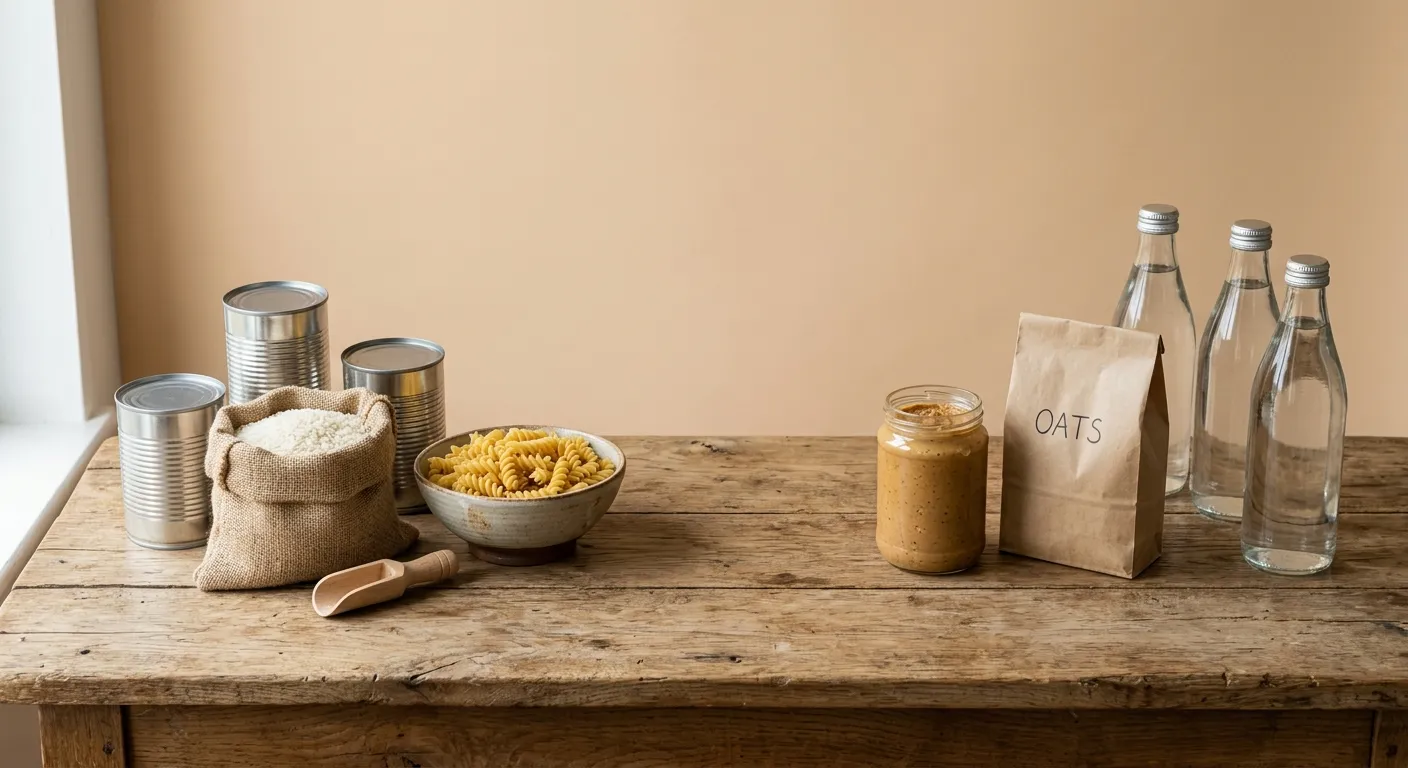
Protein: ready-to-eat canned meat, fish, beans; peanut butter; nuts. Fruit and vegetables: canned fruit, canned vegetables, dried fruit, canned juices. Starch: dry cereal or granola, crackers, white rice, dry pasta, oats. Dairy: shelf-stable (UHT) or powdered milk. Energy and comfort: protein or fruit bars, hard sweets, biscuits, tea, coffee, cocoa. Infants and medical diets: formula, baby food, and whatever the household actually has to eat. Tools: a manual can opener, a spare, and eating utensils that do not need a full sink of water.
Choose foods people will eat. Salty and spicy food makes you thirstier when water may be short, which is why FoodSafety.gov tells you to go easy on both.
A worked two-week list for one adult
This is a shopping list, not a meal plan. Quantities are ordinary supermarket packs that cover roughly two weeks for one adult if you also have a way to boil water for rice, pasta or oats. If you may have no heat at all, shift the list toward ring-pull tins, peanut butter, cereal and bars, and drop the dry rice and pasta.
| Item | Amount | Why it is here |
|---|---|---|
| Bottled water | 14 gal / 53 L | FEMA minimum for 14 days |
| Canned fish or meat (tuna, salmon, chicken) | 8 to 10 small tins | Ready-to-eat protein |
| Canned beans or lentils | 8 tins | Protein and bulk |
| Canned vegetables | 8 tins | Ready.gov list |
| Canned fruit | 6 tins | High-acid; rotate within 12 to 18 months |
| Peanut butter | 1 jar (about 400 to 500 g) | No cooking, high energy |
| White rice or dry pasta | 1.5 to 2 kg | Cheap bulk if you can boil water |
| Oats or dry cereal | 1 kg | Breakfast with UHT or powdered milk |
| Crackers | 2 boxes | No-cook starch |
| UHT milk or powdered milk | 2 litres equivalent | Ready.gov non-perishable milk |
| Dried fruit and nuts | 500 g | Ready.gov high-energy food |
| Protein or fruit bars | 8 to 14 | Go-bag overlap; no prep |
| Cooking oil | 500 ml | Calories and frying if you can cook |
| Salt, sugar or honey, tea or coffee | small packs | FEMA lists salt, sugar, tea and coffee as long keepers |
| Manual can opener | 1, plus a spare | Required if any tin lacks a ring pull |
For a household of four, multiply the food column by four, then adjust for ages and diets. Do not multiply baby formula or medical foods; buy those to the actual need. Pet food is extra, with extra water.
A three-day version is about a quarter of the table: a few tins, a jar of peanut butter, cereal, bars, and 3 gallons of water per person. That smaller set also belongs in the go bag.
Shelf life, so the list does not go to waste
USDA FSIS figures for unopened commercial tins kept cool and dry:
- High-acid (fruit, tomatoes, juice, pickles): 12 to 18 months.
- Low-acid (meat, fish, most vegetables, beans, pasta meals, most soups): 2 to 5 years.
- Dry rice and pasta: about 2 years on the USDA shelf-stable table; white rice kept dry often lasts longer in practice.
- Home-canned food: use within 1 year.
FEMA's older booklet also groups peanut butter, jelly, cereals and canned fruit as foods to use within about a year, and salt, sugar, white rice and dry pasta as the long-stay staples. Buy what you already cook, put new packs behind old ones, and eat from the front. A list you never cook from is a donation to the bin.
Emergency pantry questions
What should be on an emergency pantry list?
Water at one gallon per person per day, then ready-to-eat tins of meat, fish, beans, fruit and vegetables, peanut butter, cereal, dried fruit, shelf-stable milk, a manual can opener, and any infant or medical foods the household needs. That is the Ready.gov list in one sentence.
How much food do I need for two weeks?
FEMA suggests considering a two-week store. For water that is 14 gallons (53 litres) per person. For food, plan meals you will actually eat, or use about 28,000 kilocalories per adult as a planning check, not a medical prescription.
Do I need freeze-dried emergency meals?
No. FoodSafety.gov says you do not have to buy special emergency food. Ordinary supermarket tins and dry goods are what the official lists are built from.
What if I cannot cook?
Put the weight on ring-pull tins, peanut butter, crackers, cereal, nuts, dried fruit and bars. Keep rice and pasta only if you have a safe outdoor way to boil water.
Where this comes from
Quantities and the two-week home store are from FEMA, Food and Water in an Emergency. The food types are from Ready.gov: Food and FoodSafety.gov: Food safety in a disaster or emergency. Tin shelf lives are from USDA FSIS: Shelf-Stable Food Safety. The 2,000 kcal/day figure is a Nutrition Facts reference amount, not a FEMA calorie ration. Follow the dates on the packs in front of you.
Related guides
Be prepared!