What Does a First Aid Kit Contain?
Official contents lists with quantities: American Red Cross for a family of four, ANSI/ISEA Z308.1-2021 Class A and B, NHS home items, and the HSE workplace minimum.
The short answer
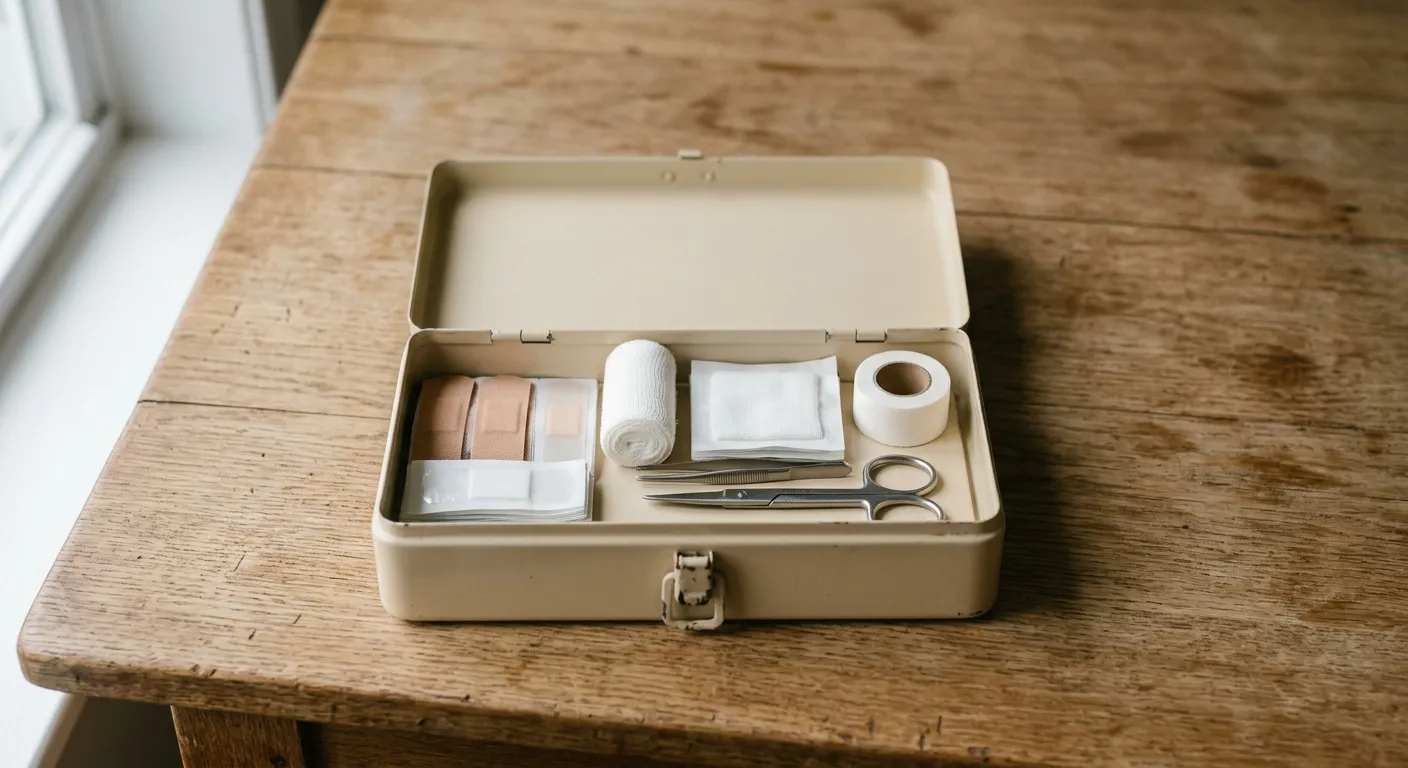
A first aid kit is dressings, gloves, tape and a few tools for bleeding, burns, sprains and minor wounds. It is not a pharmacy. The American Red Cross says you can buy one or build one, keep one at home and in the car, check dates, and replace what you use.
There is no single legal list for a house. There are four lists worth copying from, depending on whether you want a family box, a US workplace kit, or a UK home or work kit. Quantities below are the published minimums, not a shopping dare.
American Red Cross, family of four
The Red Cross home list (Anatomy of a first aid kit):
| Item | Quantity |
|---|---|
| Absorbent compress dressings, 5 x 9 in | 2 |
| Adhesive bandages (plasters), assorted | 25 |
| Adhesive cloth tape, 10 yards x 1 in | 1 |
| Antibiotic ointment packets, about 1 g | 5 |
| Antiseptic wipe packets | 5 |
| Aspirin packets, 81 mg | 2 |
| Emergency (foil) blanket | 1 |
| Breathing barrier with one-way valve | 1 |
| Instant cold compress | 1 |
| Non-latex gloves, large | 2 pairs |
| Hydrocortisone ointment packets, about 1 g | 2 |
| Gauze roller bandage, 3 in | 1 |
| Roller bandage, 4 in | 1 |
| Sterile gauze pads, 3 x 3 in | 5 |
| Sterile gauze pads, 4 x 4 in | 5 |
| Oral thermometer, non-mercury, non-glass | 1 |
| Triangular bandages | 2 |
| Tweezers | 1 |
| First aid instructions | 1 |
Aspirin is on that list. Whether it belongs in your box is a conversation with a pharmacist or doctor, not a default. Keep prescribed items (inhaler, adrenaline auto-injector) where the person who needs them can reach them, not lost among plasters.
ANSI/ISEA Z308.1-2021 workplace minimums
US workplace kits are classed by hazard, not by family size. OSHA points at ANSI Z308.1 in an appendix to 29 CFR 1910.151. The 2021 revision is the current contents table. Class A is common workplace injuries; Class B is higher hazard and adds a splint, a tourniquet and a 4 in roller bandage, with larger counts.
| Item | Class A | Class B | Size |
|---|---|---|---|
| Adhesive bandage | 16 | 50 | 1 x 3 in (2.5 x 7.5 cm) |
| Adhesive tape | 1 | 2 | 2.5 yd (2.3 m) |
| Antibiotic application | 10 | 25 | 0.5 g |
| Antiseptic | 10 | 50 | 0.5 g |
| Burn dressing, gel soaked | 1 | 2 | 4 x 4 in |
| Burn treatment | 10 | 25 | 0.9 g |
| Cold pack | 1 | 2 | 4 x 5 in |
| CPR breathing barrier | 1 | 1 | |
| Eye covering | 2 | 2 | 2.9 sq in |
| Eye/skin wash | 1 fl oz (30 ml) | 4 fl oz (118 ml) | |
| First aid guide | 1 | 1 | |
| Foil blanket | 1 | 1 | 52 x 84 in |
| Hand sanitiser | 10 | 20 | 0.9 g |
| Exam gloves | 2 pairs | 4 pairs | |
| Roller bandage 2 in | 1 | 2 | 4 yd |
| Roller bandage 4 in | 0 | 1 | 4 yd |
| Scissors | 1 | 1 | |
| Splint | 0 | 1 | 4 x 24 in |
| Sterile pad 3 x 3 in | 2 | 4 | |
| Tourniquet | 0 | 1 | 1.5 in wide |
| Trauma pad 5 x 9 in | 2 | 4 | |
| Triangular bandage | 1 | 2 | 40 x 40 x 56 in |
A home kit can borrow Class A counts without pretending to be a worksite kit. Class B's tourniquet and splint are only useful if someone present knows how to use them.
NHS home kit and HSE work kit
NHS home-cabinet lists (for example Nottinghamshire APC) add everyday extras the US tables treat as optional: a thermometer, tweezers, eyewash, antiseptic cream or spray, waterproof plasters in mixed sizes, sterile dressings and bandages. Medicines stay in a separate, child-proof place.
UK workplaces are not required to buy a branded kit. HSE says contents follow a needs assessment. For low-risk, desk-based work its suggested minimum is:
- a first aid guidance leaflet (HSE publishes one)
- individually wrapped sterile plasters, assorted sizes
- sterile eye pads
- triangular bandages, preferably sterile
- safety pins
- large and medium sterile unmedicated wound dressings
- disposable gloves
Employers may use BS 8599-1 kits. That British Standard is guidance, not a legal mandate. Typical small / medium / large / travel fills include, among other items:
| Item | Small | Medium | Large | Travel |
|---|---|---|---|---|
| Sterile adhesive dressings | 40 | 60 | 100 | 10 |
| Nitrile gloves (pairs) | 6 | 9 | 12 | 2 |
| Alcohol-free wipes | 20 | 30 | 40 | 4 |
| Sterile medium dressings | 2 | 4 | 6 | 0 |
| Sterile large dressings | 2 | 3 | 4 | 1 |
| Triangular bandage | 2 | 3 | 4 | 1 |
| Foil blanket 130 x 210 cm | 1 | 2 | 3 | 1 |
| Burn dressing, min 100 cm2 | 1 | 2 | 2 | 0 |
| Resuscitation face shield | 1 | 1 | 2 | 1 |
| Shears | 1 | 1 | 1 | 1 |
HSE: check the kit regularly. Sterile items have dates. Replace what is expired. For undated sterile items, ask the maker. For non-sterile undated items, judge whether they are still fit for purpose.
What people forget, and how to keep it usable
- A paper list of emergency numbers, medicines and allergies.
- Any personal medical devices the household is prescribed, stored as the clinician said.
- A torch, because injuries happen in the dark.
- Child and pet extras, with a paediatrician or vet if needed.
- Training. A kit without someone who can put a dressing on is a box of fabric.
Red Cross: check regularly, replace used items, throw out anything out of date. Twice a year, with the food and battery check, is a rhythm that works. Keep the home kit where adults can find it and children cannot empty it. Keep medicines out of it if the box is ever left in a hot car or a damp bathroom.
First aid kit questions
What does a first aid kit contain?
Dressings and plasters, bandages, tape, antiseptic, gloves, scissors, a foil blanket and instructions. The Red Cross family-of-four list also includes a thermometer, tweezers, a cold pack, a breathing barrier and ointment packets. Workplace kits add eyewash, burn dressings and, in higher-hazard kits, a splint and tourniquet.
What is in a basic home first aid kit?
Plasters, sterile gauze and dressings, a roller bandage, triangular bandages, tape, antiseptic wipes, gloves, tweezers, scissors, a thermometer and a foil blanket cover most minor injuries. NHS lists also mention eyewash.
How many plasters should be in a first aid kit?
Red Cross, family of four: 25 assorted adhesive bandages. ANSI Class A: 16 of 1 x 3 in. ANSI Class B: 50. BS 8599-1 small workplace: 40 sterile adhesive dressings.
Do first aid kit contents expire?
Sterile dressings, eyewash, wipes and ointments carry dates. HSE and the Red Cross both say to replace expired and used items. Check at least twice a year and after every use.
Where this comes from
Family list: American Red Cross, Anatomy of a first aid kit. Workplace quantities: ANSI/ISEA Z308.1-2021, as tabulated in manufacturer summaries of the standard (OSHA references Z308.1 in 29 CFR 1910.151 Appendix A). UK work minimum: HSE, What to put in your first aid kit and HSE first aid FAQs on BS 8599-1. NHS home extras: Nottinghamshire APC medicines cabinet leaflet. This is general information, not medical advice or a substitute for a first aid course.
Related guides
Be prepared!